Green nephrology.
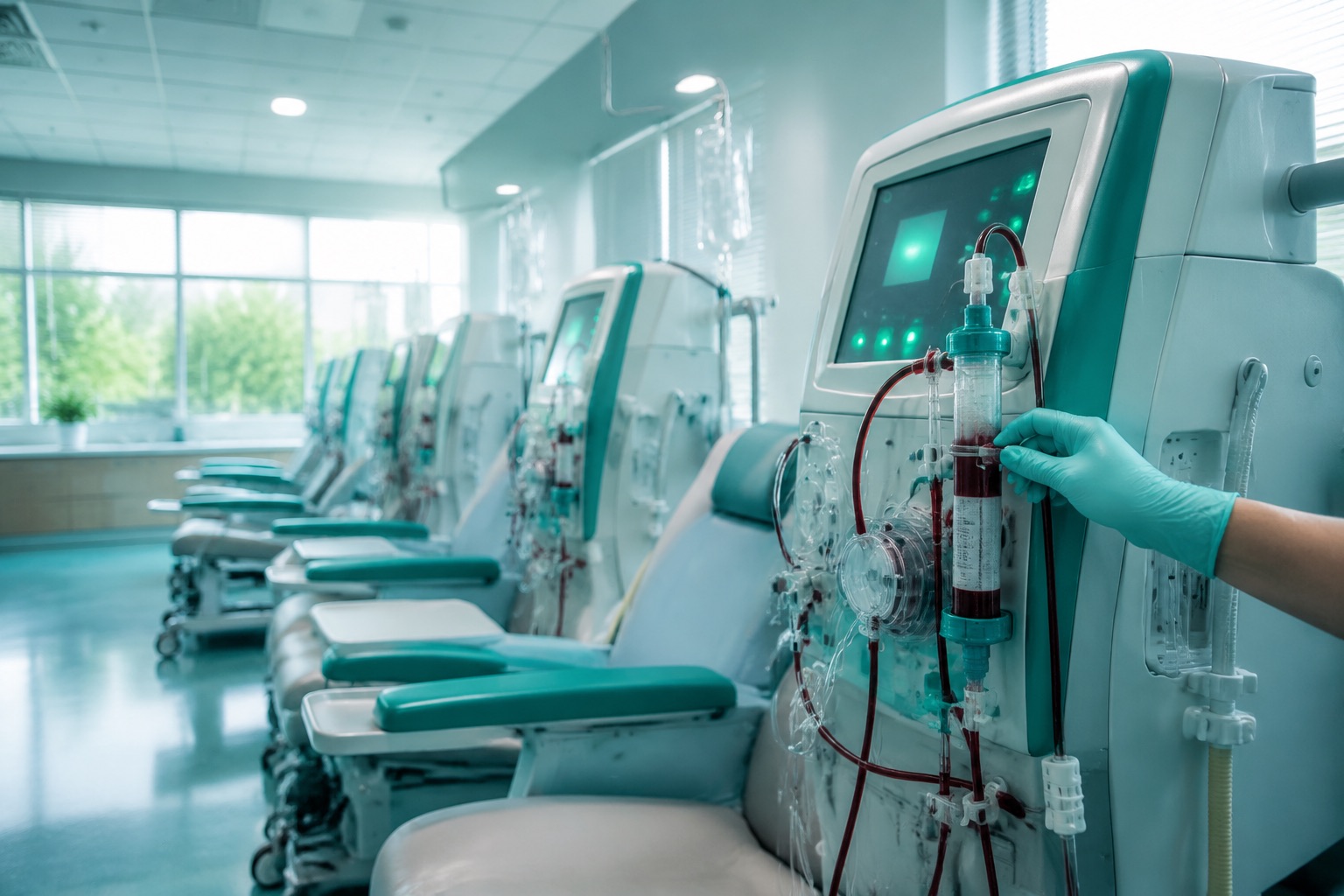
Every haemodialysis session moves hundreds of litres of water and draws power around the clock. Green nephrology has moved from values talk to circular design papers — the actions below are where departments are actually cutting.
Every action, graded.
Evidence grades travel with every claim. Click through to the study behind each number.
| ID | Action | Evidence | CO₂e / yr |
|---|---|---|---|
| ACT-021 | Reduce dialysate flow where clinically appropriate Green nephrology review — Frontiers in Medicine 2026, DOI 10.3389/fmed.2026.1793544 |
Cohort / modelling | 12 t/yr |
| ACT-022 | Assess your machines against low-impact dialysis technology Advancing dialysis technology — Curr Opin Nephrol Hypertens 2026, DOI 10.1097/mnh.0000000000001220 |
Cohort / modelling | context |
| ACT-023 | Survey PD patients on what 'green' care means to them PD patient survey — Journal of Nephrology 2026, DOI 10.1093/joneph/aajag073 |
Estimated — local audit needed | qual. |
| ACT-024 | Design consumables out: circular dialysis pilots Circular dialysis design — Journal of Nephrology 2026, DOI 10.1093/joneph/aajag162 |
Estimated — local audit needed | est. |
| ACT-025 | Batch transport for satellite dialysis patients Frontiers in Medicine 2026 review, transport section — DOI 10.3389/fmed.2026.1793544 |
Estimated — local audit needed | est. |
Before you start.
Clinical care comes first
Dialysate reduction is prescription-level. Nothing here overrides a nephrologist's judgement.
Water is the visible metric
Litres per session is your baseline everyone understands — start the audit there.
Which dialysis fits is a question about someone's life, not about tonnes.
Every action on this page passes through this gate.
PD and HD exist side by side because different lives need different things — the guideline position is shared decision-making. Carbon only ranks options that are already clinically right for this person. And the surveys say something every dialysis unit should hold onto: patients treating at home feel climate guilt more often than centre patients. So the single greenest thing a programme can do is make sure no patient ever feels their treatment burdens the planet.
| Who | What usually fits | Why | Where carbon fits in |
|---|---|---|---|
| Residual kidney function, capable & supported at home | PD / assisted PD — and ask about incremental PD | Preserves residual function, home autonomy, fewer trips; iPD is gentler still | After suitability is settled — and check where the fluid ships from |
| Frail, elderly, or cognitively affected | In-centre HD | Frailty prevalence 20–80% in HD cohorts; the centre carries the complexity | It doesn't. Counting carbon here is counting the wrong thing. |
| Lives alone, no home support, values clinic contact | In-centre HD | Refusal drivers: family burden (OR 7.54), social isolation (OR 7.18) — these are real | It doesn't. If you want the carbon down, talk to the manufacturer and the logistics — not the patient. |
| Long commute, PD-suitable, locally supplied fluid | PD genuinely lower-carbon | Threshold 12.6–31 km; beyond it travel dominates | The maths holds — but the choice stays with the patient |
What the data shows.
Case: the patient behind the litre count.
Behind the 62-litre hour is a person spending 12–15 hours a week attached to a machine, whose EQ-5D quality-of-life index averages 0.486 on dialysis — down from 0.706 at earlier CKD stages. A Canadian survey of 69 dialysis patients found something we should sit with: those on home therapies (PD and home HD) reported climate guilt and anxiety significantly more often than in-centre patients. They can see their own waste. The greenest modality decision is the one the patient can actually live with — no spreadsheet justifies adding eco-anxiety to a dialysis diagnosis. Where carbon genuinely belongs: incremental PD prescribing that protects residual kidney function cuts emissions up to 50% while being gentler on the patient — a clinical win that happens to be green, not a green policy imposed on the clinic.
CKJ 2026 · DOI 10.1093/ckj/sfag156; Qual Life Res 2026 · DOI 10.1007/s11136-025-04154-z; CKJ 2026 · DOI 10.1177/20543581261434815
Asked and answered.
Does the guideline prefer PD — should HD be phased out?
No. The guidelines (KDIGO 2025 shared-decision framework) never ranked one above the other — they say the decision belongs to the patient and clinician together: PD suits patients with residual kidney function, dexterity, suitable housing and support at home; in-centre HD is the right choice for frail patients, those with abdominal surgery history, hernias, or no home support — frailty prevalence in HD cohorts runs 20–80%. Both modalities exist because different lives need different things. Carbon does not get a vote in that decision.
What actually drives whether home PD is greener?
Distance and supply chains, not the therapy itself. LCA work across four European centres shows PD footprints range 1,736–3,381 kg CO₂e/patient-year; shipping fluid cross-country can make home PD higher-carbon than in-centre HD. Home wins on carbon only beyond a 12.6–31 km commute threshold — and local fluid production cuts PD footprint 15–63%. If you want that number down, the question is where the fluid is manufactured — not which patient to lean on.
Why do patients refuse home dialysis?
Real reasons, measured (Scandinavian study): reluctance and fear (OR 7.29), the burden it places on family (OR 7.54), social isolation (OR 7.18), unsuitable housing (OR 3.64). These are life circumstances, not information deficits. A department that listens to them is practising both better medicine and more honest sustainability.
What saves first: water, power or consumables?
Dialysate-flow optimisation where clinically appropriate carries the measured number (12 t CO₂e/yr modelled) — prescription-level, case by case. Machine replacement cycles decide the rest: assess low-impact technology at procurement. And where incremental PD is clinically suitable, it wins twice: residual function preserved, emissions halved.